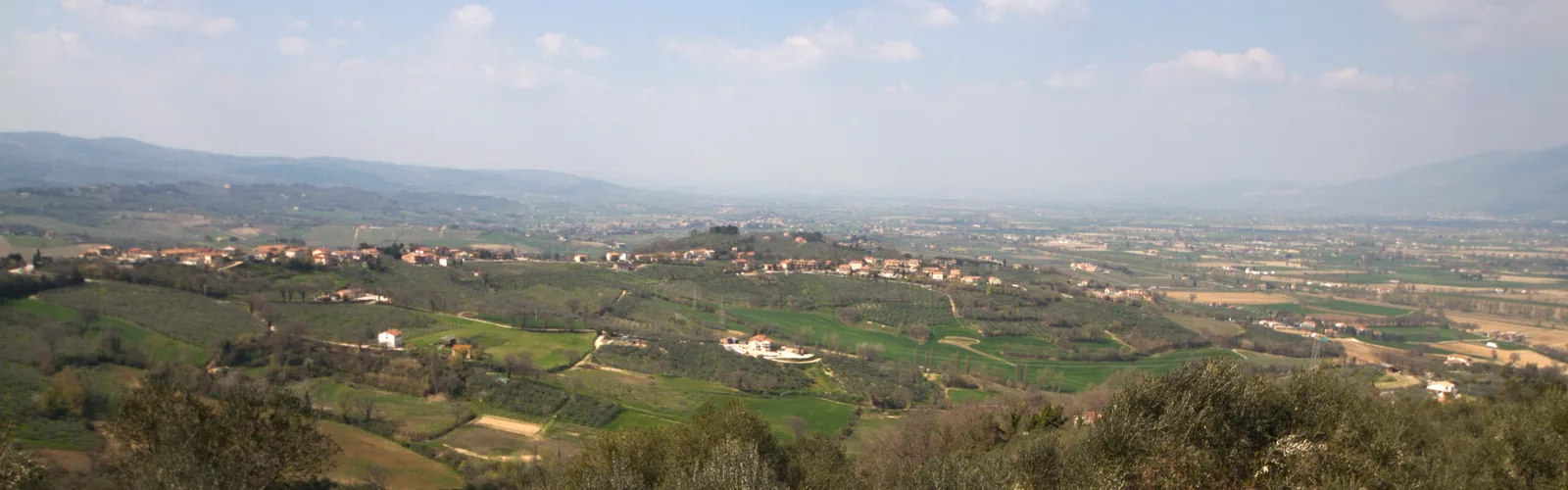
Montefalco, Umbria: Sagrantino Wine, What to See & Day Trip from Spoleto
Montefalco is a hill town in Umbria known for panoramic views, Renaissance frescoes and Montefalco Sagrantino DOCG, one of central Italy’s most distinctive red wines.
About 25 km from Spoleto, it works well as a half-day visit, a wine-focused day trip, or as part of a Montefalco–Bevagna route for travelers exploring Umbria by car.
For many international visitors, Montefalco first appears on a wine label rather than on an itinerary. That can make the town seem like a destination only for serious wine enthusiasts. It is not. Montefalco is also one of the most rewarding small historic towns in central Umbria: compact, walkable, rich in art, and positioned high above vineyards and olive groves with views across the Umbrian valley.
This guide is written for travelers who do not speak Italian and may know little about Umbrian wine. It explains what Sagrantino is, what DOC and DOCG mean, what else to taste, what to see in town, how winery visits work, where to park, how the ZTL works, and how to combine Montefalco with Spoleto, Bevagna or Trevi.
Why Visit Montefalco?
Montefalco is often called the “Balcony of Umbria” because of its elevated position and wide views over the surrounding valleys. The historic centre is enclosed by medieval walls and rises toward Piazza del Comune, while the slopes below are covered with olive groves and vineyards.
The town offers three experiences in one place: a medieval Umbrian hill town, an important Renaissance art stop, and the centre of the Sagrantino wine area. That combination makes it especially useful for travelers who want more than a conventional sightseeing day.
| Region | Umbria, central Italy |
| From Spoleto | About 25 km; roughly 30–35 minutes by car |
| Known for | Montefalco Sagrantino DOCG, panoramic views, Benozzo Gozzoli frescoes |
| How long to allow | 3–4 hours for the town; most of a day with a winery tasting |
| Best combined with | Bevagna, Trevi or a wider Spoleto-based itinerary |
| Car useful? | Yes, especially for wineries and multi-town days |
What to See in Montefalco
1. Piazza del Comune
Montefalco’s historic centre naturally pulls you uphill toward Piazza del Comune. This is the town’s main square and the best place to understand its scale: medieval and later civic buildings surround an irregular central space now lined with cafés, restaurants and wine bars.
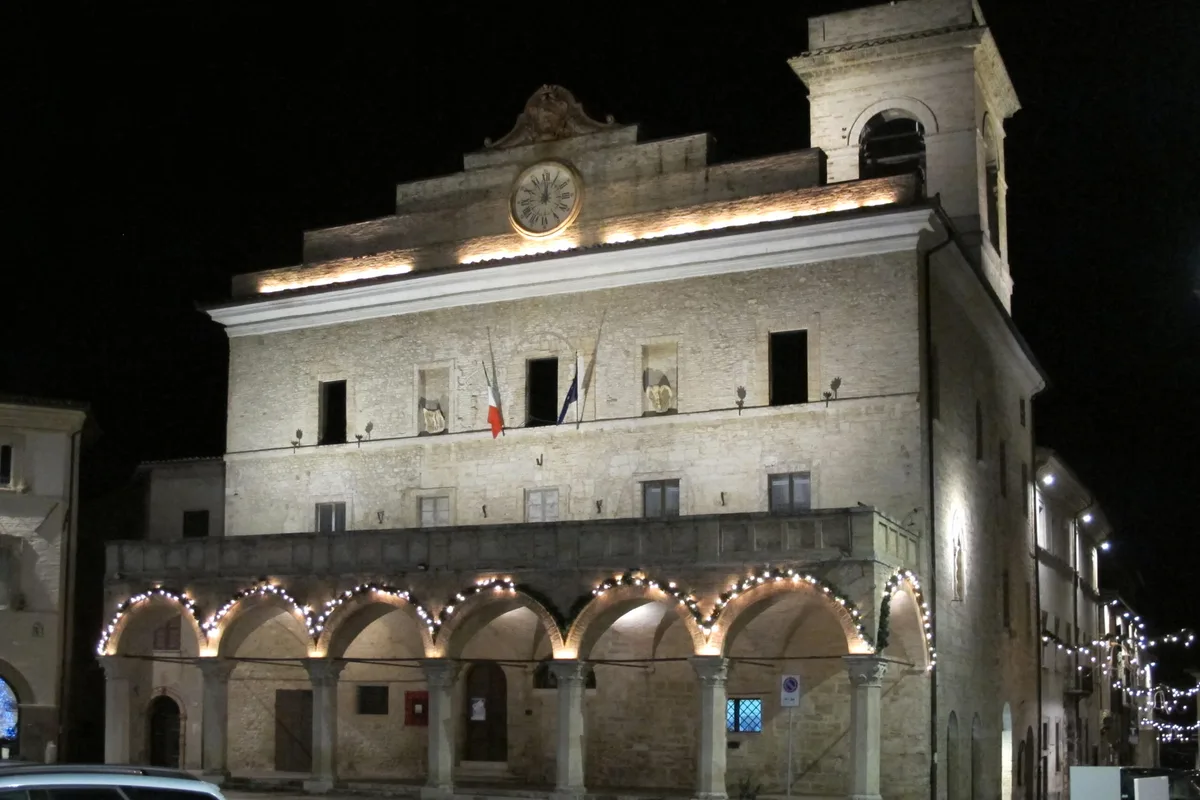
The square is also practical for visitors: it is an easy reference point for the museum, restaurants and the streets leading toward panoramic viewpoints. If you arrive without a detailed plan, begin here.
2. Museum Complex of San Francesco
The Museum Complex of San Francesco is the cultural highlight of Montefalco and should not be treated as an optional extra. The former Franciscan church was built in the 14th century and is now a museum containing one of the most important Renaissance fresco cycles in Umbria.
In the apse, Benozzo Gozzoli painted twenty episodes from the life of Saint Francis in 1452. The church also contains a Nativity by Perugino from 1503. The museum continues through the picture gallery, archaeological collections and the old Franciscan cellars.
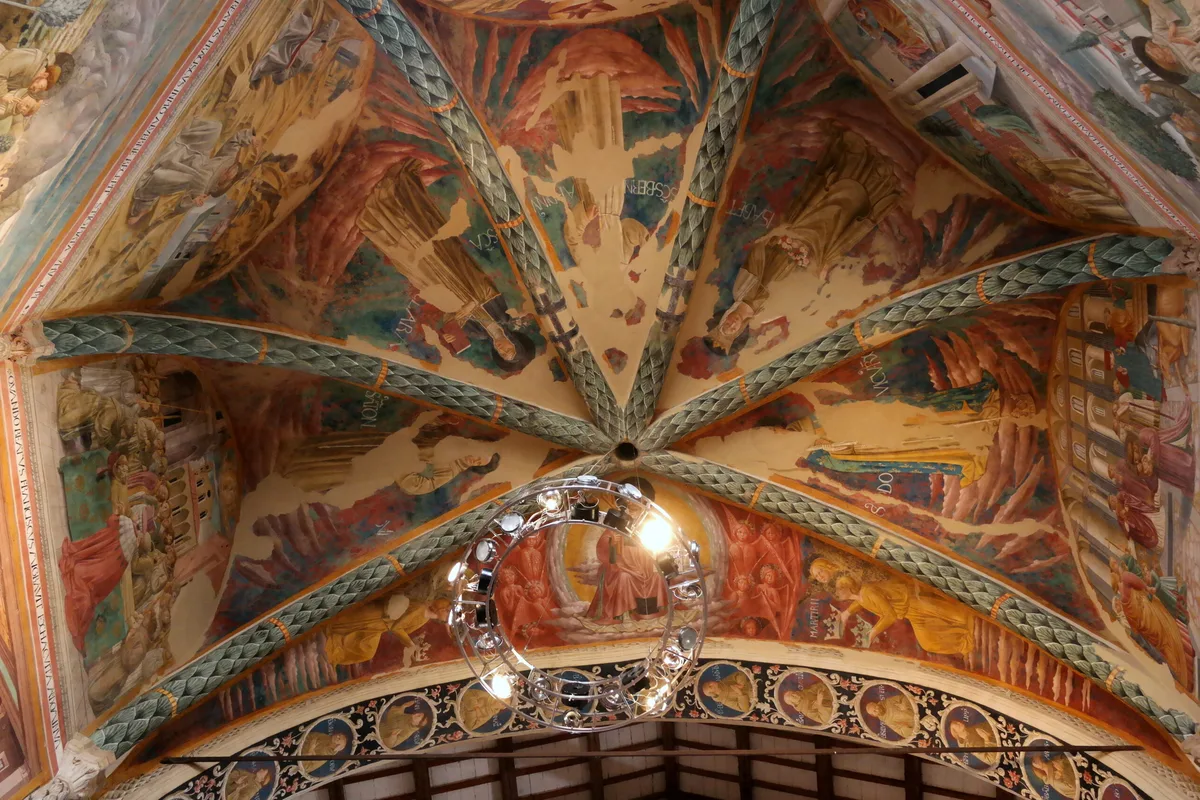
For travelers interested in Saint Francis, this makes Montefalco a natural complement to Assisi and Spoleto. You can also continue with our guide to Saint Francis in Umbria, Assisi and Spoleto.
3. The Sagrantino Museum
The Sagrantino Museum, opened in 2024 inside the San Francesco complex, is particularly useful for visitors who enjoy wine but do not already understand local grape varieties. The route begins in the old Franciscan cellars and explains the relationship between Sagrantino, the landscape and Montefalco’s agricultural history.
The museum also introduces other wines of the area, including Montefalco Rosso DOC, Montefalco Grechetto DOC and Trebbiano Spoletino. This is a good first stop before a winery tasting because it gives context to what you will later see in the glass.
Check current opening times and tickets on the official Museum of San Francesco website.
4. Sant’Agostino, Santa Chiara and the Medieval Streets
Do not leave Montefalco immediately after the museum. Walk through the streets around Sant’Agostino, continue toward Santa Chiara della Croce, and allow time simply to follow the lanes inside the walls. The town is small enough to explore without a formal route.
Because Montefalco rises toward its centre, you repeatedly encounter views between buildings and over the countryside. These short pauses are an important part of the visit and help explain the “Balcony of Umbria” nickname.
Sagrantino for Beginners: What Is It?
Sagrantino is a native red grape associated above all with Montefalco and the surrounding hills. If you have never heard of it before arriving in Umbria, that is normal: it is far less internationally familiar than Sangiovese, Nebbiolo or Pinot Grigio, but locally it is central to the identity of the territory.
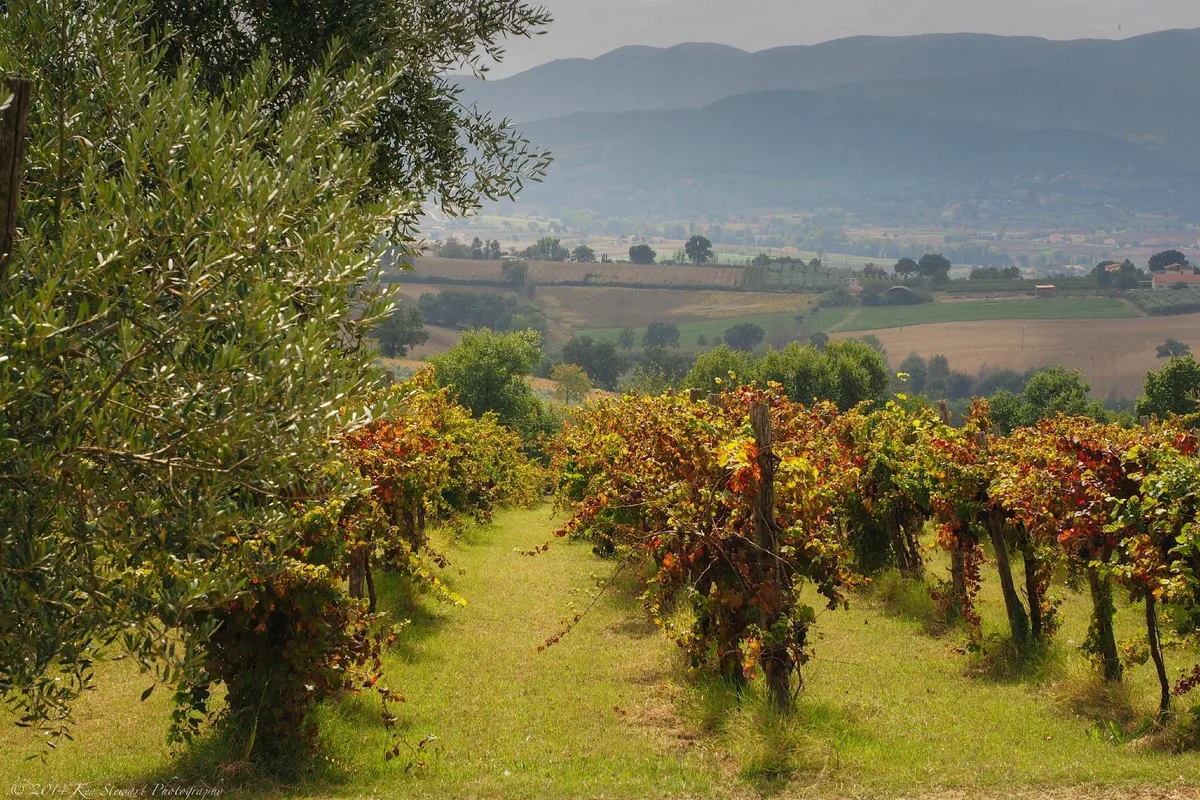
Montefalco Sagrantino DOCG is made from 100% Sagrantino. The grape naturally produces deeply colored, structured wines with substantial tannins, which is why good examples are built for ageing and are commonly paired with robust foods rather than treated as light aperitif wines.
The official Consorzio describes typical pairings including aged cheeses, steak, braised meats and game. If you are tasting for the first time, do not worry about identifying every aroma. The important thing is to notice the wine’s structure, concentration and firm tannic texture.
You can read the official denomination information on the Consorzio Tutela Vini Montefalco website.
Dry Sagrantino and Sagrantino Passito: What Is the Difference?
Montefalco Sagrantino exists in both a dry version and a traditional Passito version. “Passito” means the grapes are dried after harvest so their sugars and flavors become more concentrated before fermentation.
The dry version is the style most international wine drinkers now associate with Sagrantino: powerful, structured and suited to ageing. The Passito version preserves an older tradition and is sweet, but still balanced by the grape’s naturally strong tannic character.
Do Not Taste Only Sagrantino: Other Montefalco Wines to Know
A common first-time mistake is to visit Montefalco and taste only the most famous DOCG. The local wine picture is broader.
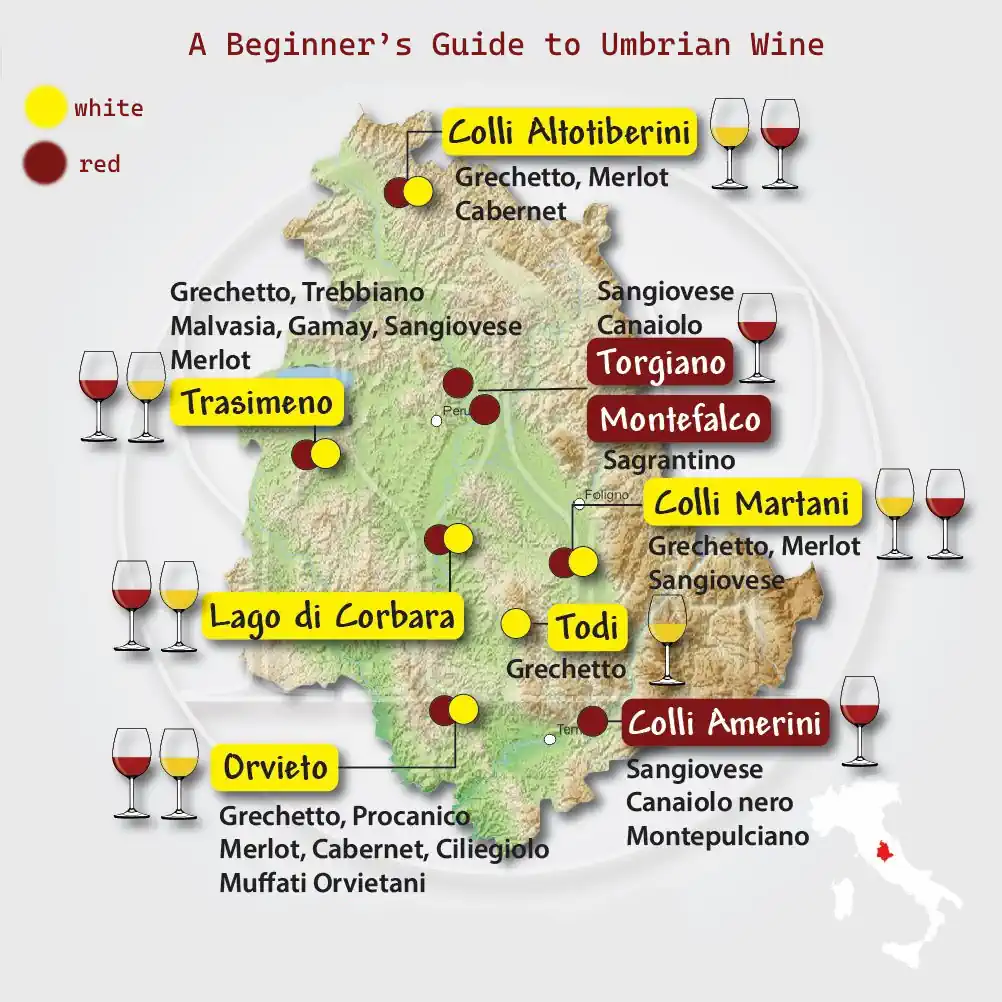
Montefalco Rosso DOC
Montefalco Rosso DOC is generally easier to approach when young. Under the current denomination rules it is made with 60–80% Sangiovese, 10–25% Sagrantino and up to 30% other permitted red grapes. It combines Sangiovese’s familiar profile with some of Sagrantino’s local character.
Montefalco Bianco DOC
Montefalco Bianco DOC contains at least 50% Trebbiano Spoletino. For travelers who think central Italian wine means red wine only, this is worth seeking out.
Montefalco Grechetto DOC
Montefalco Grechetto DOC is made with at least 85% Grechetto, another grape closely associated with Umbria. It offers a useful contrast to the more structured reds.
The official blend rules and pairing guidance are available on the Montefalco DOC page of the Consorzio.
DOC, DOCG and Wine Labels: A Simple Explanation
If you do not speak Italian, wine labels can look unnecessarily complicated. Two terms matter most here:
- DOC means Denominazione di Origine Controllata: the wine follows rules defining where and how it can be produced.
- DOCG adds Garantita and represents a more tightly controlled denomination. Montefalco Sagrantino carries DOCG status.
You do not need to memorize Italian wine law to enjoy a tasting. For a visitor, the denomination is mainly a reliable clue that the wine is tied to a defined place and production rules.
How to Plan a Wine Tasting in Montefalco if You Do Not Speak Italian
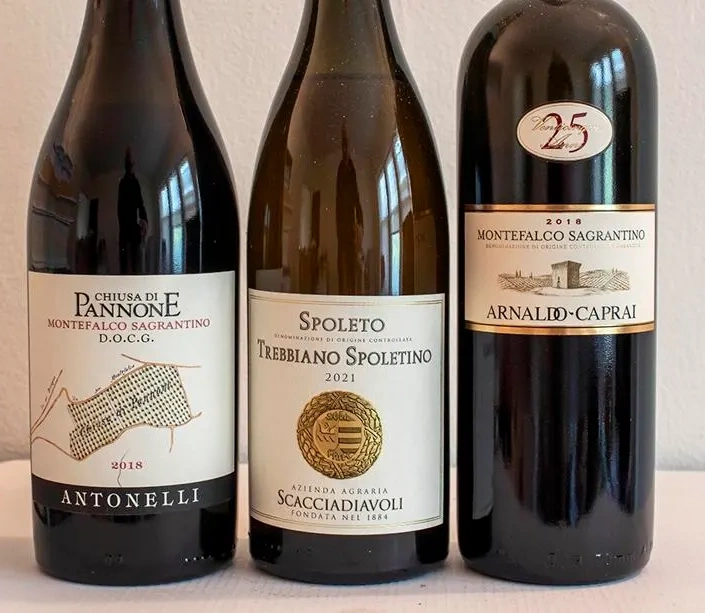
You do not need to speak Italian to visit the Montefalco wine area, but book ahead whenever possible. Many wineries are working agricultural businesses rather than walk-in tasting rooms, and English-language visits are easier to organize when requested in advance.
- Choose one or two wineries rather than trying to visit many in a day.
- Ask whether the tasting is available in English before booking.
- Allow roughly 60–120 minutes for a meaningful cellar visit and tasting.
- If you are driving, appoint a designated driver or limit consumption appropriately.
- Do not assume every winery accepts walk-ins, especially outside high season.
The official Consorzio winery map is the best starting point because it lists producers across Montefalco and the surrounding denomination area without forcing you into a commercial ranking.
An Easy Tasting Without Choosing a Winery
For visitors who want to understand the wines before committing to a full winery visit, the Consorzio’s “Montefalco nel Bicchiere” program is particularly useful. In the 2026 edition, tastings have been scheduled on Saturdays at 16:00 at the San Francesco Museum complex, with five wines from Spoleto DOC, Montefalco DOC and Montefalco Sagrantino DOCG.
The published 2026 format lasts about one hour and costs €15, with advance booking requested by Friday at 13:00. Because seasonal schedules can change, verify the current program on the official Consorzio page before planning your day.
Wine Events in Montefalco
Montefalco’s major wine calendar is not limited to winery visits. Enologica Montefalco – Abbinamenti is the principal September wine-and-food event, bringing together local denominations, food, art, music and cellar experiences. The 2026 edition took place from 18 to 20 September.
If you are planning a future autumn trip, check the Consorzio events calendar for the next edition rather than relying on old dates.
How Long Do You Need in Montefalco?
Three to four hours is enough to explore the historic centre, visit the San Francesco museum and enjoy the panoramic viewpoints at a comfortable pace.
If you add a winery visit or structured tasting, plan most of a day. Montefalco becomes much more satisfying when you do not have to hurry from a museum directly into a tasting and then immediately back into the car.
Parking and ZTL in Montefalco
Montefalco has an electronically controlled ZTL — a limited traffic zone — at the entrances to the historic centre. The monitored gates are at Porta Sant’Agostino, Porta della Rocca and Via Federico II. If the sign indicates the ZTL is active, do not enter unless your vehicle is authorized.
For the current 2026 summer schedule, valid from 1 May to 31 October, the Municipality lists the ZTL as active on weekdays from 13:00–16:00 and 19:00–02:00, on Saturdays and pre-holidays from 10:00–02:00, and on Sundays and holidays from 10:00–02:00. Different restrictions may apply during major events.
Outside the historic centre, practical parking options include areas around Viale della Vittoria and near Porta Sant’Agostino. Always follow local signs because access and parking arrangements can change.
Check the latest official information on the Municipality of Montefalco ZTL page before driving into the centre.
How to Get to Montefalco from Spoleto
Montefalco is about 25 km from Spoleto, and driving normally takes around 30–35 minutes. A car is the easiest option if you also want to visit wineries, Bevagna or Trevi on the same day.
Travel without a car is possible, usually via Foligno and local bus connections, but it is less convenient for winery visits because estates are spread through the countryside rather than concentrated inside the historic centre.
Montefalco and Bevagna in One Day
Montefalco and Bevagna are one of the best two-town combinations in central Umbria. They are only around 10 km apart, yet they offer very different experiences.
- Morning in Bevagna: Piazza Filippo Silvestri, Roman baths, medieval churches and a relaxed walk through the historic centre.
- Lunch: eat in Bevagna or continue toward Montefalco.
- Afternoon in Montefalco: San Francesco Museum, Sagrantino Museum, panoramic views and a pre-booked wine tasting.
- Evening: return to Spoleto and keep the same accommodation base.
Use our full Bevagna guide to plan the first half of the route.
Montefalco and Trevi: Another Easy Route
If your interests lean more toward olive landscapes, medieval streets and panoramic driving, combine Montefalco with Trevi. This creates a useful contrast between Montefalco’s wine identity and Trevi’s olive-oil traditions.
Best Time to Visit Montefalco
Spring is excellent for walking, vineyards and clear views. Early autumn is particularly attractive for wine travelers because harvest activity and wine events give the area more energy. Summer has long daylight hours but can be hot, especially in the middle of the day.
Winter is quieter and can be appealing if you prefer uncrowded streets, but winery and museum schedules should be checked in advance. For wine-focused travel, always confirm tasting availability before setting out.
Is Montefalco Worth Visiting if You Are Not a Wine Expert?
Yes. Montefalco works because the wine is only one layer of the destination. Even without a tasting, the San Francesco frescoes, medieval centre and wide Umbrian views justify the trip. If you are curious about wine but inexperienced, the town is actually a good place to start because the Sagrantino Museum and structured tastings provide context rather than assuming specialist knowledge.
Where to Stay for Montefalco, Bevagna and Central Umbria
If Montefalco is one stop in a wider Umbria trip, changing accommodation for every small town is usually unnecessary. Spoleto works well as a base for reaching Montefalco, Bevagna, Trevi, Foligno, Spello and the Valnerina while still giving you a substantial historic city to return to in the evening.
Adagio Umbro is a boutique B&B in Spoleto, set in a historic countryside property about 3 km from the historic centre. Breakfast and internal parking are included, and staying guests can use the private tennis court by reservation.
For travelers exploring Umbria by car, the practical advantage is simple: you can spend the day in wine country and return to the same quiet base rather than repacking every night. See our guide to where to stay in Spoleto or check rooms and direct availability.
Frequently Asked Questions About Montefalco
What wine is Montefalco famous for?
Montefalco is best known for Montefalco Sagrantino DOCG, a red wine made from 100% Sagrantino grapes. The area also produces Montefalco Rosso DOC, Montefalco Bianco DOC and Montefalco Grechetto DOC.
Is Sagrantino a dry or sweet wine?
Both styles exist. Montefalco Sagrantino DOCG is produced as a dry red wine and as Sagrantino Passito, a traditional sweet version made from dried grapes.
Do I need to book wine tastings in Montefalco?
Booking is strongly recommended. Many wineries organize visits at specific times and English-language tours may need to be requested in advance.
Can I visit Montefalco without speaking Italian?
Yes. The main cultural sites provide visitor information, and many wine producers work with international guests. When booking a winery, confirm that your chosen time is available in English.
How much time do I need in Montefalco?
Allow three to four hours for the historic centre and museum. Add at least one to two hours if you are visiting a winery.
Can I visit Montefalco and Bevagna in the same day?
Yes. They are only around 10 km apart and complement each other well: Bevagna for Roman and medieval history, Montefalco for Renaissance art, views and wine.
Is Montefalco easy to reach from Spoleto?
Yes by car. Montefalco is about 25 km from Spoleto and the drive is usually around 30–35 minutes.
Official Resources for Planning Your Visit
- Consorzio Tutela Vini Montefalco – official denomination, winery and event information.
- Official winery map.
- Museum of San Francesco – official English website.
- Municipality of Montefalco – ZTL information.
- Umbria Tourism – Montefalco.
Image credits: hero panorama by trolvag / Wikimedia Commons, CC BY-SA 3.0; Piazza del Comune by Sailko / Wikimedia Commons, CC BY-SA 3.0; Benozzo Gozzoli fresco photograph by Luca Aless / Wikimedia Commons, CC BY-SA 4.0. Images were cropped and converted to WebP for web use. Other wine images are from the Adagio Umbro media library.
Stay Connected
For more updates, photos, and stories from Adagio Umbro, follow us on our social media channels: