Bevagna, Umbria: What to See, Roman Mosaics & Day Trip from Spoleto
Bevagna is a compact historic town in Umbria where Roman remains, Romanesque churches, artisan traditions and Piazza Filippo Silvestri can all be explored on foot.
About 27 km from Spoleto by road, it works especially well as a half-day trip or as part of a Bevagna–Montefalco day itinerary for travelers exploring central Umbria by car.
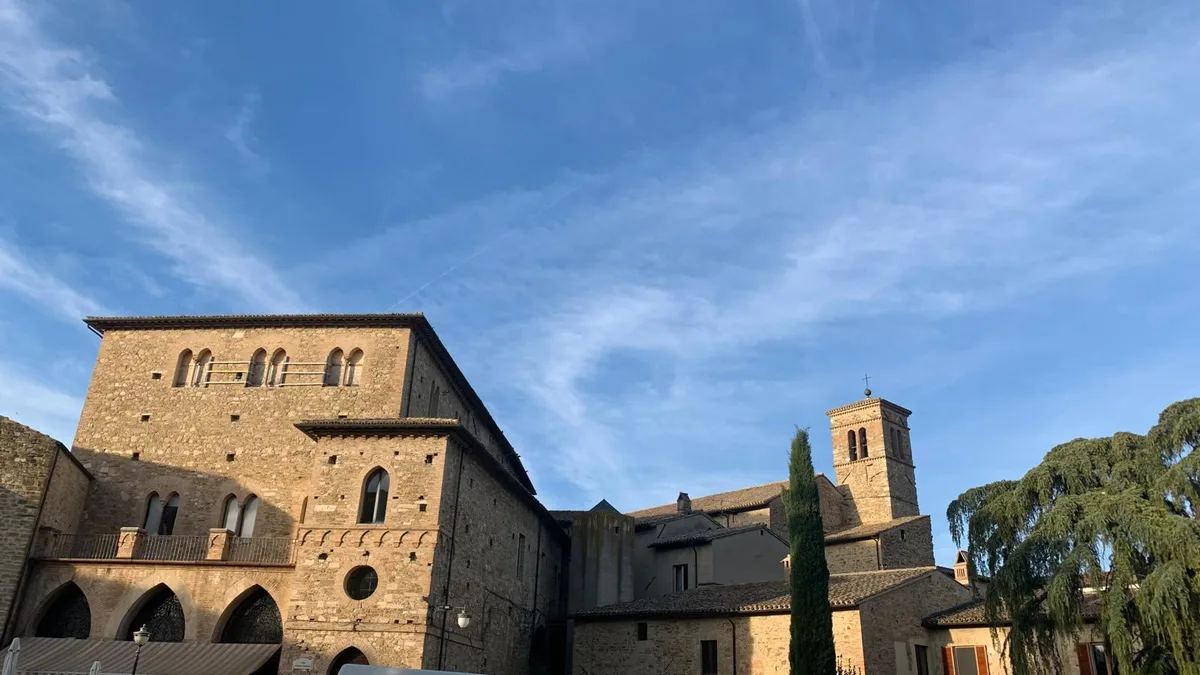
Bevagna is easy to overlook on a map because it is not perched dramatically on a hill like many Umbrian towns. That is part of its appeal. The historic centre sits on the valley floor, enclosed by walls and crossed by streets that still reveal the layout of ancient Mevania, the Roman town that once stood on the Via Flaminia.
For visitors, Bevagna offers an unusually concentrated mix of Roman and medieval history. You can stand in one of Umbria’s most atmospheric medieval squares, visit a Roman bath complex with a black-and-white marine mosaic, see churches built with reused Roman stone, and then walk into streets where the town’s medieval craft traditions are still actively interpreted through the Mercato delle Gaite.
This guide is written for international visitors who may be seeing the name Bevagna for the first time and want practical answers: what is worth seeing, how long to stay, where to park, whether you need a car, and how to combine Bevagna with other places in central Umbria.
Why Visit Bevagna?
Bevagna is particularly rewarding if you like places where different periods of history overlap rather than appearing in separate archaeological zones. Roman remains are woven directly into the medieval town: houses follow the curve of the ancient theatre, fragments of Roman buildings survive in later structures, and the Roman baths sit only a short walk from the main square.
It is also a manageable place to visit. The historic centre is compact, the principal sights are close together, and the town is much less physically demanding than many Umbrian hill towns. For travelers moving through Umbria by car, Bevagna therefore works well both as a destination in its own right and as part of a wider route through Spoleto, Montefalco, Trevi, Foligno or Spello.
Bevagna at a Glance
| Region | Umbria, central Italy |
| Historic Roman name | Mevania |
| From Spoleto | About 27 km by road, roughly 30–35 minutes by car |
| How long to allow | 2–3 hours for the centre; half a day with museums; a full day if combined with lunch and Montefalco |
| Best for | Roman history, medieval architecture, artisan traditions, slow travel and food/wine itineraries |
| Car useful? | Yes, especially if combining Bevagna with other Umbrian towns |
What to See in Bevagna
1. Piazza Filippo Silvestri
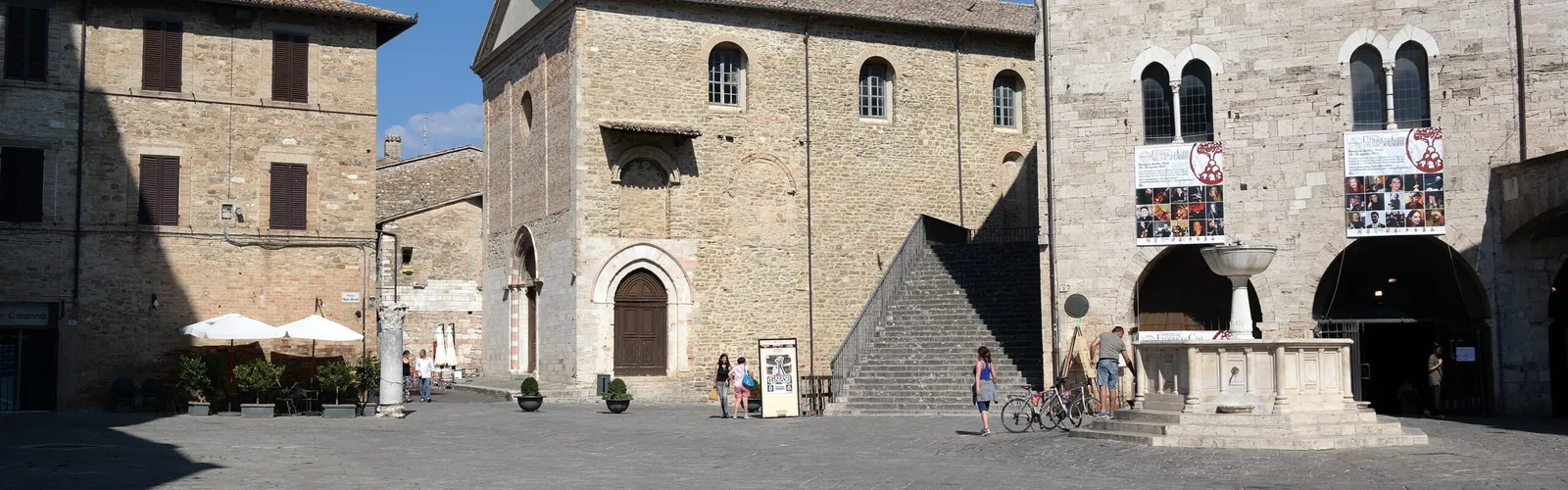
Start in Piazza Filippo Silvestri, the architectural heart of Bevagna. The square took shape mainly between the 12th and 13th centuries and brings together several of the town’s most important medieval buildings: the churches of San Silvestro and San Michele Arcangelo, Palazzo dei Consoli and the later Teatro Francesco Torti.
What makes the square memorable is not symmetry but the opposite: the buildings sit at different angles and create a space that feels accumulated over centuries rather than formally planned. A Roman column also survives in the piazza, one of many reminders that medieval Bevagna developed directly over the ancient town.
The institutional tourism portal of Bevagna describes Piazza Silvestri as the centre of the town’s medieval development. You can read the official description on Visit Bevagna.
2. Roman Baths and the Marine Mosaic
One of Bevagna’s most important archaeological sights is the surviving Roman bath complex. The frigidarium preserves a refined black-and-white mosaic dating from the 2nd century AD, decorated with marine subjects. Restoration work has also identified traces of the calidarium, the heated section of the baths.
The mosaic is one of the clearest ways to understand that Bevagna was already an important settlement long before its medieval churches and palaces were built. Official visitor information is available on the Bevagna tourism portal.
3. San Silvestro and San Michele Arcangelo
The two Romanesque churches facing Piazza Silvestri are among the strongest reasons to visit Bevagna if you are interested in medieval architecture.
San Silvestro is dated by an inscription to 1195 and is associated with the master Binello. Its restrained stone interior, raised presbytery and crypt create a striking contrast with the busier architecture of many later Italian churches.
San Michele Arcangelo, built around the same period, continues the Romanesque character of the piazza. Together, the two churches make it possible to understand Bevagna not just as a picturesque village but as a town with a coherent medieval urban identity.
4. Palazzo dei Consoli and Teatro Francesco Torti
Palazzo dei Consoli, dating to the 13th century, dominates one side of Piazza Silvestri. Inside it is the much later Teatro Francesco Torti, a small 19th-century theatre whose decorated interior adds another historical layer to the building.
Bevagna’s museum network links the theatre with the Civic Museum and Roman Baths, so visitors interested in interiors and archaeology should check current opening arrangements before arriving. The official tourism portal lists the museum circuit and contact information on its museum page.
5. The Roman Theatre Hidden Inside the Town
Bevagna’s Roman theatre is not presented as a single monumental ruin. Instead, later houses were built over and around it, preserving the curve of the ancient structure within the modern street plan. Parts of the supporting ambulatories survive inside private buildings.
This is one of the most interesting aspects of Roman Bevagna: the ancient city is not separate from the medieval one. It is literally underneath and inside it. The official description of the remains is available from Visit Bevagna.
6. Museo Civico at Palazzo Lepri
The Civic Museum in Palazzo Lepri brings together archaeological material, medieval documents and paintings from local churches. It is useful if you want to place the Roman and medieval remains you see around town into a wider historical context.
The museum collection includes archaeological material from the archaic, Republican and Imperial periods, medieval parchments, and paintings dating from the 15th to the 18th centuries.
7. Church of San Francesco and the Franciscan Connection
At the higher end of the historic centre stands the Church of San Francesco, built at the end of the 13th century on the site of an earlier church. Local tradition preserves a direct connection with Saint Francis: a stone kept near the altar is associated with the place where Francis is said to have stood when preaching to the birds at nearby Pian d’Arca.
For travelers following Franciscan places in Umbria, this creates a natural connection between Bevagna, Assisi and Spoleto. The official Bevagna tourism site provides more detail on the Church of San Francesco.
Mercato delle Gaite: Why Bevagna Is Famous for Medieval Crafts
International visitors may see the name Mercato delle Gaite without immediately understanding what it means. It is Bevagna’s major medieval historical reenactment, normally held in June, when the town’s four historic districts — called gaite — recreate aspects of medieval life through crafts, markets, food, competitions and performances.
The distinctive part is the emphasis on historical crafts. Workshops reconstruct activities such as papermaking, candle making, silk production, painting, minting and other medieval techniques. The cultural circuit of medieval crafts also operates beyond the main festival period, with visits available by arrangement.
If the Mercato delle Gaite is one of the reasons for your trip, check the official Mercato delle Gaite website for current dates, bookings and workshop openings.
How Long Do You Need in Bevagna?
Allow at least two to three hours if you want to walk through the historic centre, see Piazza Silvestri, visit the principal churches and stop for coffee or lunch.
A half day is better if you also want to visit the Roman Baths, Civic Museum and Teatro Torti without rushing. If you are interested in medieval craft workshops or are visiting during the Mercato delle Gaite, Bevagna can easily occupy most of the day.
How to Get to Bevagna from Spoleto
For travelers staying in Spoleto, driving is the simplest option. The road distance is about 27 km and the journey usually takes around 30–35 minutes, depending on traffic and the route you choose.
Without a car, travel is possible but less direct. Bevagna does not have its own railway station; the usual public-transport route involves taking a train from Spoleto to Foligno and continuing by bus. If your broader Umbria itinerary includes villages, wineries or olive-oil areas, a car gives substantially more flexibility.
If you are planning several road trips from Spoleto, our Spoleto visitor guide and guide to Trevi can help you build a wider central Umbria itinerary.
Parking and ZTL in Bevagna
Bevagna’s historic centre includes a ZTL — a limited traffic zone. If you are unfamiliar with driving in Italy, do not treat a navigation app as permission to enter a restricted street. Follow the road signs and use the designated parking areas outside or at the edge of the historic centre.
As of October 2026, the Municipality lists paid parking for cars at Piazzale Masci Minolfo, Piazzale dell’Accoglienza and Piazzale Clitunno. The published parking hours are 09:00–13:00 and 14:00–20:00, with a standard car tariff of €1.20 per hour and a €6 daily maximum. Regulations can change, especially during events, so always check the signs when you arrive.
You can verify the latest parking information on the Municipality of Bevagna parking page and current traffic restrictions on the official ZTL information page.
Can You Visit Bevagna and Montefalco in One Day?
Yes — this is one of the easiest two-town combinations in central Umbria. Bevagna and Montefalco are only around 10 km apart by road. A relaxed day could look like this:
- Morning: drive from Spoleto to Bevagna and explore Piazza Silvestri, the Roman remains and the historic centre.
- Lunch: stay in Bevagna for an Umbrian lunch or continue toward Montefalco.
- Afternoon: visit Montefalco for its hilltop views, Sagrantino wine culture and historic centre.
- Evening: return to Spoleto rather than changing accommodation for a single night.
If you prefer a route focused more on olive landscapes and hill towns, Bevagna can also be combined with Trevi, around 20–25 minutes away by car.
Best Time to Visit Bevagna
Bevagna works well through much of the year. Spring and autumn are especially comfortable for walking and combining the town with countryside drives. June is the key period for visitors specifically interested in the Mercato delle Gaite, while autumn makes it easy to combine Bevagna with wine, olive-oil and food experiences elsewhere in Umbria.
Summer can be hot in the middle of the day, but Bevagna’s compact centre means you can alternate outdoor walking with churches, museums and lunch. In winter, check museum and church opening times before travelling because schedules can be more limited.
Is Bevagna Worth Visiting?
Yes, particularly if you want a town that combines Roman archaeology with a lived-in medieval centre. Bevagna is not simply another attractive Umbrian village. Its strongest feature is the continuity between ancient Mevania and the later medieval town: Roman streets and structures remain embedded in the urban fabric, while the Mercato delle Gaite keeps medieval craft traditions visible in a way that is unusual even within Umbria.
It is also practical. You can see a meaningful amount in a few hours, parking is available around the historic centre, and the town is close enough to Montefalco, Trevi and Spoleto to form part of a multi-day central Umbria itinerary.
Where to Stay for Visiting Bevagna and Central Umbria
If your trip includes Bevagna together with Spoleto, Trevi, Montefalco, the Valnerina or other parts of central Umbria, using Spoleto as a base can be more convenient than changing accommodation between individual towns.
Adagio Umbro is a boutique B&B in Spoleto, set in a historic countryside property approximately 3 km from the historic centre. Breakfast and internal parking are included, and staying guests can use the private tennis court by reservation.
From Spoleto, Bevagna is around half an hour away by car, while other day-trip routes can take you toward Trevi, Foligno, Spello, Assisi or the Valnerina. See our guide to where to stay in Spoleto or check rooms and direct availability.
Frequently Asked Questions About Bevagna
Where is Bevagna in Italy?
Bevagna is in Umbria, in central Italy, in the Valle Umbra between the areas of Foligno, Montefalco and Assisi. It is about 27 km by road from Spoleto.
What is Bevagna famous for?
Bevagna is known for Piazza Filippo Silvestri, its Roman remains and mosaics, Romanesque churches and the Mercato delle Gaite, a major medieval historical reenactment centred on the town’s four historic districts and craft traditions.
How much time do you need in Bevagna?
Two to three hours are enough for a useful first visit to the historic centre. Allow half a day if you want to visit the Roman Baths, museum and theatre, and longer if you plan lunch or medieval craft activities.
Can I visit Bevagna and Montefalco on the same day?
Yes. The two towns are around 10 km apart by road, making Bevagna and Montefalco one of the easiest two-stop itineraries in central Umbria.
Is Bevagna easy to visit by car?
Yes, provided you respect the ZTL. Use one of the designated municipal parking areas and continue into the compact historic centre on foot.
Can I visit Bevagna without speaking Italian?
Yes. Bevagna is straightforward to explore independently, and the official municipal tourism portal has an English-language section. For museums, guided visits or craft workshops, check language availability when booking.
Official Visitor Information
- Visit Bevagna – institutional tourism portal
- Mercato delle Gaite – official website
- Municipality of Bevagna – parking information
- Municipality of Bevagna – ZTL information
Hero image: Luca Aless / Wikimedia Commons, CC BY-SA 4.0. Cropped to 1600 × 500 and converted to WebP.
Stay Connected
For more updates, photos, and stories from Adagio Umbro, follow us on our social media channels: