Ponte delle Torri Spoleto: Italy’s Most Spectacular Medieval Bridge
Ponte delle Torri in Spoleto is one of Umbria’s most iconic landmarks, linking the Rocca Albornoziana to Monteluco above the Tessino valley.
This guide explains its history, architecture, best viewpoints, and practical tips for visiting one of the most striking medieval bridges in central Italy.
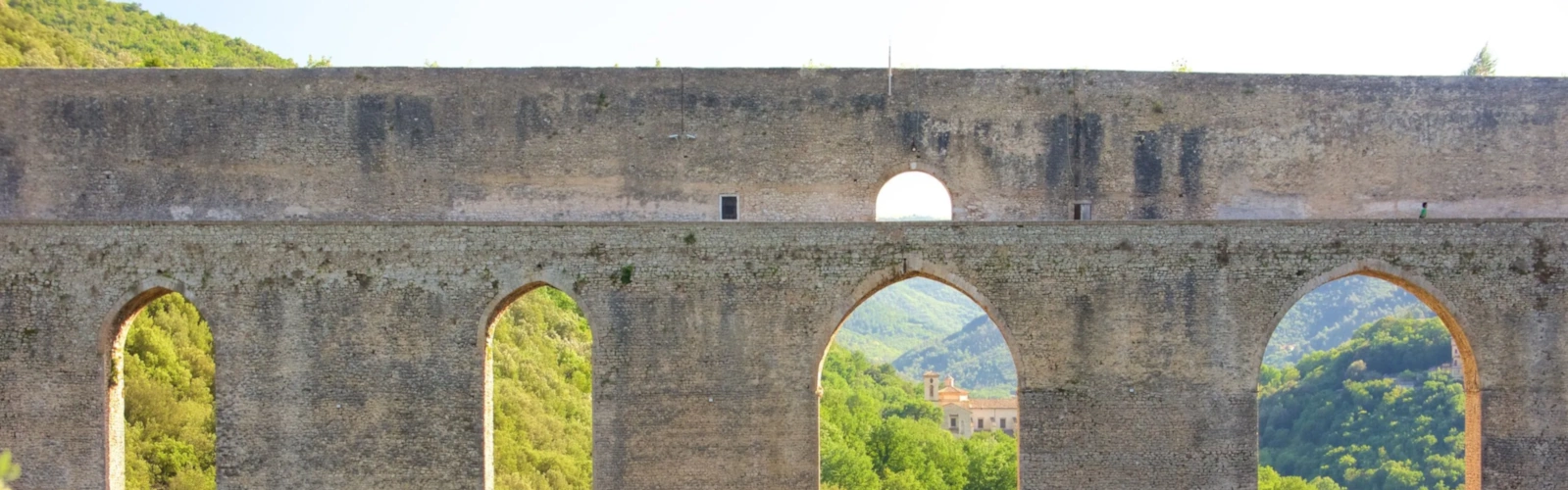
Ponte delle Torri in Spoleto is one of the tallest medieval bridges in Italy, stretching about 230 meters across the Tessino valley. Built in the 13th century, it once served as both an aqueduct and a defensive passage linking the Rocca Albornoziana fortress to Monteluco forest. Today visitors can walk across the bridge and enjoy one of the most dramatic views in Umbria.
Few sights in Umbria are as unforgettable as Ponte delle Torri, the dramatic bridge that appears in nearly every panoramic photograph of Spoleto. Towering above the green Tessino valley and connecting the medieval fortress to the sacred mountain of Monteluco, it is one of central Italy’s most iconic pieces of architecture. For centuries, travelers, writers and engineers have described it with the same reaction: awe.
Today, after years of structural restoration, Ponte delle Torri is open again — and for many visitors, it has instantly become the highlight of their trip to Umbria.
This guide focuses on practical information, historical context, and travel tips for international visitors.
A Landmark with Ancient Roots
The origins of Ponte delle Torri are partly hidden in time, but several facts are firmly established.
1. The structure visible today is medieval (13th century).
Most historians date the current bridge to the late 1200s, when Spoleto was an important strategic town between Rome and the Duchy of Spoleto’s mountain territories.
2. It was likely built on top of a Roman aqueduct.
Findings of Roman stonework, alignment, and the typical Roman practice of combining aqueduct and defensive elements strongly support this theory. However, the Roman origin is partly hypothetical — the exact Roman structure has not survived in full, but archaeological evidence makes it highly probable.
3. It served a dual function: aqueduct + defensive connection.
The upper channel brought water from Monteluco into Spoleto. Meanwhile, its elevated walkway allowed soldiers to cross quickly without descending into the valley.

4. The bridge survived earthquakes but required modern restoration.
Umbria is seismic, and although the bridge has resisted centuries of earthquakes, closures were necessary after the 2016 events for safety checks and major consolidation works. These works were completed, allowing a safe reopening.
Understanding the Architecture: Why the Bridge Looks So Unique
Ponte delle Torri is striking because of its proportions and engineering clarity. Here are the verified architectural facts:
• Length: approx. 230 meters (755 ft)
• Height: approx. 80 meters (262 ft)
• Number of arches: 10
• Material: limestone blocks from local quarries
• Function: aqueduct + pedestrian/defensive route
The ten arches are not uniform: they increase in size as the valley deepens. This gives the bridge its dramatic “stair-like” rhythm and creates perfect photographic symmetry from any vantage point.
The structure is massive — its walls are extremely thick — but its proportions are elegant, creating the illusion of lightness when seen from a distance.
Interestingly, despite its size, the bridge has no decorative elements. Everything is structural, functional, and purposeful. That’s why architects admire Ponte delle Torri: it is medieval engineering at its most rational and modern.
Historical Visitors and Famous Mentions
The bridge has fascinated writers and travelers for centuries. One of the most notable descriptions comes from Lord Byron, who called it “sublime”. His reference cemented Ponte delle Torri in the European cultural imagination as a bridge worth traveling to see.
Other documented visitors included 19th-century scholars and Grand Tour travelers who often compared the bridge to ancient Roman aqueducts such as those near Rome or Segovia — yet noted that its vertical drop and single-span height made it incomparable.
The Bridge and Spoleto’s Landscape
Ponte delle Torri sits between two equally important landmarks:
1. The Rocca Albornoziana
A 14th-century papal fortress dominating Spoleto’s skyline. From its terraces, you get the classic postcard photo: the full arches of the bridge floating above the trees.
2. Monteluco Forest
A sacred mountain covered with holm oaks, historically inhabited by hermits and monks. The bridge gave direct access to the monastic area.
The setting is part of the attraction: the combination of stone architecture, deep valley, and untouched greenery is genuinely breathtaking.
The Bridge Today: Reopened and Safe to Visit
Ponte delle Torri is currently accessible to visitors free of charge.
The reopening followed years of engineering work to reinforce the stone structure and guarantee safety for pedestrians.
You can now:
- walk across at any time
- take dogs on a leash
- cycle (slowly and with respect for pedestrians)
- enjoy one of the most scenic passages in Umbria
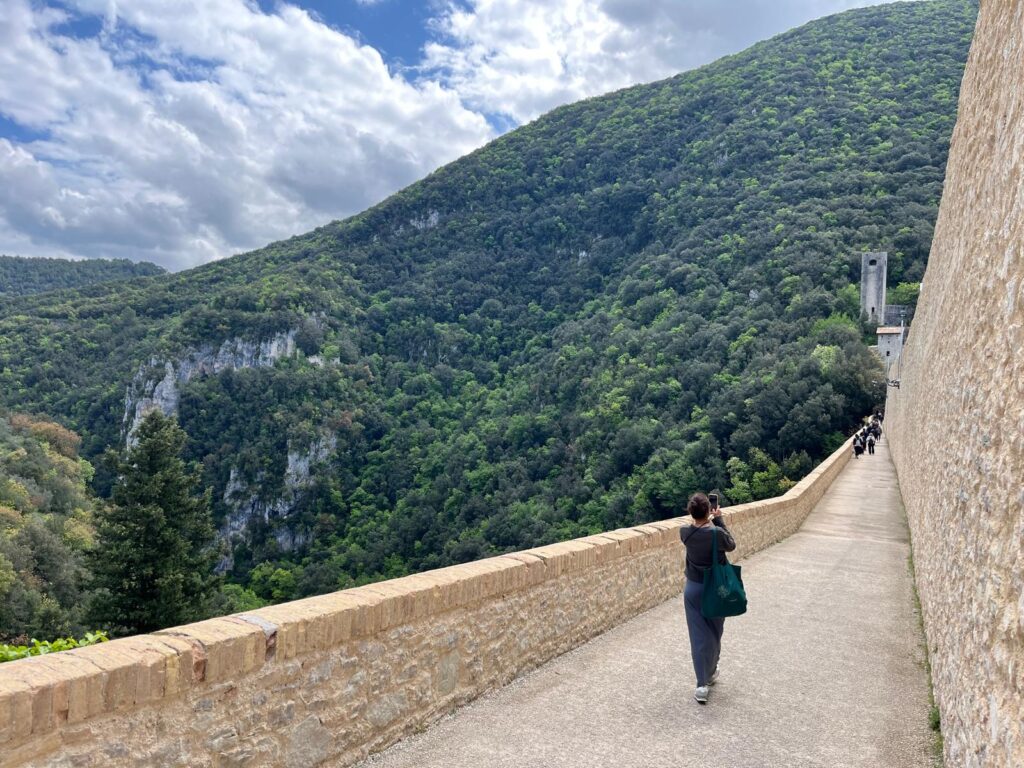
The crossing takes about 10–15 minutes at a relaxed pace, but most people spend more time photographing the views.
Lighting
In the evening, Ponte delle Torri is gently illuminated along its pedestrian walkway, creating a safe and pleasant atmosphere for visitors. At the same time, the full structure is clearly visible from a distance — especially from the main Terni–Perugia road, where the bridge stands out against the hillside. Thanks to this balanced lighting, the bridge remains impressive both up close and from afar, making sunset and early evening excellent times to admire and photograph it.

Is the Bridge Difficult to Walk?
The walk is flat, straightforward, and accessible to most visitors.
However, the approach from Spoleto’s center includes uphill medieval streets or escalators leading to the fortress level.
Wear comfortable shoes — the stones can be slightly uneven, as expected for medieval pathways.
Active holidays in Umbria include hiking in the Sibillini Mountains, cycling routes like the Spoleto–Norcia trail, and outdoor activities surrounded by nature. The area around Spoleto offers direct access to trails, quiet roads, and authentic countryside landscapes.
Explore hiking and cycling in Umbria →
You can also book a private outdoor activity near Spoleto: tennis court rental in a private villa setting →
What Else to See in Spoleto (Curated for International Tourists)
• Spoleto Cathedral (Duomo)
One of Italy’s most beautiful Romanesque façades, with frescoes by Fra Filippo Lippi.
• Roman Theater & Archaeological Museum
Still used for summer performances; excellent preservation.
• Basilica of San Salvatore (UNESCO)
A remarkable early-Christian church from the 4th–5th century.
• Rocca Albornoziana
Magnificent views and a fascinating interior courtyard.
• Monteluco Forest
Perfect for hiking, meditation, and panoramic walks.
Why Ponte delle Torri Matters for Modern Tourism
1. It is one of the tallest medieval bridges in Italy.
Verified by architectural data — very few medieval aqueduct-bridges reach this height.
2. It is a symbol of Spoleto’s identity.
Local tourism boards consistently use it in branding.
3. It attracts both international and domestic visitors.
Recent regional statistics show strong growth in foreign tourism in Umbria, especially in nature, heritage, and slow-travel segments. Spoleto benefits directly from these trends.
4. It connects urban culture with nature.
Few cities in Italy have such a dramatic natural gateway only minutes from the historic center.
When to Visit (Accurate Seasonal Breakdown)
Spring (April–June)
Best weather, clear skies, ideal for photography. Wildflowers bloom in Monteluco.
Summer (July–August)
Hot but lively; the Festival dei Due Mondi brings concerts and international visitors.
Autumn (September–October)
Golden light, mild temperatures, excellent for walking.
Winter (November–March)
Quiet and atmospheric; the bridge can be misty in the mornings, offering dramatic photos.
Best Photo Spots (Verified by Local Photographers)
Tourists often miss the best angles. These are the confirmed top 3 locations:
1. Rocca Albornoziana terraces
The full view of all arches — the classic shot.
2. The path descending toward the valley (Sentiero dei Condotti)
A side angle showing the height and symmetry of the arches.
3. Monteluco viewpoint
A higher viewpoint for wide landscape photos.
Useful Travel Tips
- No ticket needed: the bridge is always free.
- No barriers or long security lines: easy, informal access.
- Bring water in summer: there are no fountains on the bridge itself, but Spoleto has many public drinking fountains along the walking routes leading toward Ponte delle Torri. Just bring your bottle with you — you’ll be able to refill it easily before reaching the bridge.
- Parking: best to park at the closest available parking and then take the Spoleto escalators from the lower city.
- Food nearby: try strangozzi alla spoletina, black truffle dishes, or local cured meats in restaurants near Piazza del Duomo or at Valle Rosa
Frequently Asked Questions About Ponte delle Torri
Yes. It reopened only after structural reinforcement and safety evaluations.
Yes, but watch them closely due to the height and stone walkways.
Yes, but slowly and yielding to pedestrians.
Only with authorization. The area around the Rocca is regulated.
Yes, it remains accessible 24/7.
Why Ponte delle Torri Should Be on Every Umbria Itinerary
Because it offers something rare:
a combination of untouched nature, medieval engineering, ancient history, and unforgettable views — all in one walk.
Spoleto is already a jewel of Roman, medieval, and Renaissance heritage, but Ponte delle Torri adds a spectacular outdoor experience that no photo fully captures.
For travelers exploring Tuscany and Umbria by car, for hikers seeking meaningful landscapes, or for culture-lovers following the Grand Tour routes, Ponte delle Torri feels like a discovery — even if thousands have crossed it before.
If you’re planning a trip to central Italy, don’t miss it.
And if you’re already in Umbria, make Spoleto your next stop.
Where to Stay in Spoleto and Umbria: Practical Tips for Choosing the Right Accommodation
If you are exploring the wider region, you’ll find a large variety of accommodation in Umbria: B&Bs, agriturismi, boutique hotels, country houses, and holiday apartments. Choosing the best option depends on your travel style. Staying in the historic center gives you quick access to churches, museums, and restaurants. Staying in the countryside provides views, quiet spaces, and easier parking — a major advantage for travelers arriving by car.
If you want to understand the difference between Italian accommodation categories — hotels, B&Bs, guesthouses, holiday homes, agriturismi — read our complete guide here:
Types of Tourist Accommodation in Italy
Whichever option you choose, Spoleto and the Umbrian countryside offer authenticity, nature, and a peaceful atmosphere — ideal for travelers looking to experience central Italy at a slower, more meaningful pace.
Driving in Italy: Essential Tips Every Tourist Must Know Before Renting a Car Read more →
Stay Connected
For more updates, photos, and stories from Adagio Umbro, follow us on our social media channels: