Torre dell’Olio in Spoleto: History, Meaning and How to Visit This 13th-Century Tower
Torre dell’Olio in Spoleto is a 13th-century medieval tower hidden in the historic centre. Despite its height and history, most visitors pass it without noticing. This guide explains its meaning, history, and exactly where to find it.
Torre dell’Olio in Spoleto is one of the most intriguing yet overlooked landmarks in Umbria. Hidden within the narrow medieval streets, this 13th-century tower has survived centuries of conflict, earthquakes, and urban transformation – while remaining almost invisible to most visitors.
Unlike famous monuments such as the Duomo di Spoleto or the Rocca Albornoziana, Torre dell’Olio is not part of a typical tourist route. And that is precisely its value.
If you are looking for authentic places in Spoleto beyond the main attractions, this tower represents a different way of experiencing the city – quieter, more observant, and closer to its medieval identity.
This guide explains:
- what Torre dell’Olio is
- why it has such a distinctive name
- its historical role in medieval Spoleto
- where to find it and how to visit it
- how to include it in a half-day walking route
What is Torre dell’Olio in Spoleto
Torre dell’Olio is a medieval defensive tower located in the historic centre of Spoleto, in the Umbria region of central Italy. Built between the 12th and 13th centuries, it reflects a period when towers were not only military structures but also clear symbols of power.
Families used towers to assert dominance – both visually and politically. The higher the tower, the stronger the message. In cities like Spoleto, this vertical competition shaped the skyline and defined social hierarchy.
Architecturally, Torre dell’Olio follows the typical Umbrian model:
- rectangular stone structure
- thick defensive walls
- narrow vertical development
- strategic positioning within the urban fabric
Even today, its proportions remain imposing. Although reduced from its original height (estimated around 45 metres), it still dominates the surrounding buildings and offers a clear sense of medieval scale.
What makes Torre dell’Olio particularly significant is not just its structure, but its context. It belongs to a network of towers that once defined Spoleto as a strategic city contested by the Papal States, the Holy Roman Empire, and local noble families.
Why Torre dell’Olio is Different from Other Italian Towers
Italy is known for its medieval towers – from San Gimignano to Bologna – but Torre dell’Olio stands apart for a different reason: it has not been transformed into a tourist attraction.
There are:
- no ticket offices
- no guided queues
- no commercial infrastructure
It remains embedded in everyday life, surrounded by residential streets and quiet corners of the historic centre.
This lack of “tourist packaging” makes it especially interesting for travellers who want to experience:
- hidden places in Spoleto
- authentic urban textures
- slower, more observational travel
In practical terms, it is the kind of place you discover while walking – not while following a checklist.
Before continuing, pause for a moment and look at this historical reconstruction of medieval Spoleto.

What you see is not a modern city – but a landscape dominated by towers. During the 12th and 13th centuries, Spoleto was filled with defensive structures like Torre dell’Olio, each built by noble families to display power and control.
You may want to see another historic photos of Spoleto HERE
Why is it called Torre dell’Olio in Spoleto?
Torre dell’Olio – literally “Oil Tower” – is one of the most intriguing names among medieval landmarks in Spoleto. The origin of the name is not definitively documented, but it is generally explained through a combination of historical practice and local tradition.
The defensive theory (most widely accepted)
The most credible explanation relates to medieval siege warfare. During the Middle Ages, towers like Torre dell’Olio were part of the city’s defensive system. When enemies approached the walls or attempted to break through gates, defenders stationed above would drop boiling substances onto attackers below.
These typically included:
- boiling water
- tar or pitch
- stones and debris
- and, according to tradition, boiling oil
This practice was not unique to Spoleto – it was used across Europe. However, the association with oil may have been particularly strong in Umbria, where olive oil was both widely available and economically important.
The economic context behind the name
In medieval Umbria, olive oil was more than a food product – it was a key resource used for:
- lighting
- cooking
- trade
- and, in extreme cases, defence
Using oil as a weapon would not have been routine. It was likely reserved for critical moments, when the city was under real threat. This gives the name Torre dell’Olio a more dramatic meaning: it reflects not only a defensive method, but also the intensity of conflict in medieval Spoleto.
The merchant theory (alternative explanation)
A second interpretation suggests a commercial origin. According to local accounts, the tower may have belonged to a family involved in the trade of olive oil or related products.
In this case:
- the tower could have been used for storage
- or as a visible marker of economic activity
This explanation is plausible, as towers often combined residential, defensive, and commercial functions.
What is the real origin?
There is no single confirmed explanation. Like many medieval place names in Italy, Torre dell’Olio likely reflects a blend of:
- practical function
- local economy
- and oral tradition
What remains certain is that the name has survived for centuries – outlasting political changes, linguistic shifts, and the transformation of the city itself.
Olive Oil in Umbria
Olive oil has shaped Umbrian life for centuries – from daily use to moments of conflict. This tradition continues today in nearby Trevi, one of the region’s key centres of olive oil culture.
Discover Trevi →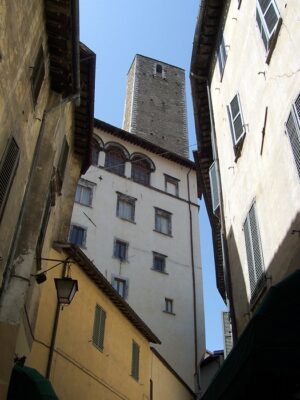


History and Legend
To understand Torre dell’Olio, it is essential to look beyond the tower itself and consider the broader context of medieval Spoleto – a city that played a strategic role in central Italy far beyond its size.
Some local interpretations connect the area around Torre dell’Olio with much earlier events in Spoleto’s history. According to tradition, nearby Porta Fuga is associated with the legendary resistance of the city against Hannibal’s troops in 217 B.C.
While this connection is not directly linked to the construction of the tower itself, it reinforces the strategic importance of this part of Spoleto across different historical periods.


Spoleto in the Middle Ages
Spoleto was once the capital of the Duchy of Spoleto, one of the most influential Lombard territories in Italy from the 6th century onwards. Even after its integration into the Papal States, the city retained both political and military importance.
Its position along key routes connecting Rome to northern Italy made it a contested location for centuries.
Between the 11th and 13th centuries – the period when Torre dell’Olio was likely built or reinforced – Spoleto became a stage for internal and external conflicts. The Guelph–Ghibelline rivalry, which divided many Italian cities, also shaped the urban structure of Spoleto.
During this time, noble families constructed towers not only for defence, but also as visible symbols of influence:
- height meant prestige
- position meant control
- visibility meant power
The Function of Medieval Towers
Towers like Torre dell’Olio were multifunctional structures, combining military, residential, and economic roles.
They typically served as:
- defensive refuges during periods of urban conflict
- symbols of wealth and status, requiring significant resources to build
- watch-points, offering visibility over streets and access routes
- storage spaces, often used for goods such as grain or oil
Upper levels were used for living, while lower levels provided storage or controlled access. Internal ladders could be removed, making entry difficult during attacks.
In this context, Torre dell’Olio was not an isolated building, but part of a wider defensive and social system that defined medieval Spoleto.
The Role of Torre dell’Olio
Although the exact family responsible for its construction is not definitively recorded, its location suggests strategic importance.
Positioned near an access point within the historic centre, the tower likely contributed to:
- monitoring movement
- controlling entry into specific areas
- reinforcing the presence of a local noble family
This aligns with the broader pattern of tower placement in medieval Italian cities.
Later History and Transformation
From the 14th century onwards, the role of towers began to change. The development of firearms reduced the effectiveness of height-based defence, and the consolidation of power under the Papal States limited the autonomy of local families.
Many towers across Italy were:
- partially dismantled
- reduced in height
- or incorporated into surrounding buildings
Torre dell’Olio likely followed a similar path.
Today, what remains is only part of the original structure – but enough to convey its historical significance. The stonework, proportions, and integration into the surrounding streets still reflect the character of medieval Spoleto.
Where to Find Torre dell’Olio and How to Visit
Torre dell’Olio is located in the historic centre of Spoleto, close to Via del Municipio and a short walk from Piazza del Mercato. It sits within a network of narrow medieval streets, which is exactly why many visitors miss it – there are no signs, no crowds, and no obvious tourist markers.
The easiest way to reach it is on foot, using Spoleto’s underground escalators and walkways, which connect parking areas to the upper city. If you are arriving by car, it is best to leave your vehicle outside the historic centre and continue walking.
You can learn how to move around efficiently in the city here:
→ How to park in Spoleto and use the underground escalators
Torre dell’Olio fits naturally into a walking route through the city. From here, you can continue towards key landmarks or explore quieter corners nearby.
→ What to see in Spoleto
Within a short distance, you can also reach major sites such as the Duomo di Spoleto, the Roman theatre, and the iconic Ponte delle Torri, which offers one of the most impressive views over the Umbrian valley.
Why Torre dell’Olio is Worth Visiting
Spoleto is known for its cathedral, its Roman heritage, and events like the Festival dei Due Mondi. Torre dell’Olio, however, sits outside this main circuit.
Standing in front of the tower means experiencing history without mediation. There are no panels, no guided paths, no curated narrative. You are simply in a medieval street, facing a structure that has stood there for centuries.
For photographers, the tower offers strong visual contrast: rough stone, narrow light corridors, and everyday life unfolding around a 13th-century structure.
For history-oriented travellers, it represents something more tangible than a museum – a direct encounter with how power, defence, and daily life once intersected in a medieval city.
For many visitors, this becomes one of the most memorable moments in Spoleto – not because it is famous, but because it feels real.
What to Explore Next
After visiting Torre dell’Olio, many travellers choose to continue beyond the historic centre and experience the surrounding landscape. Spoleto is not only about monuments – it is also a base for slower, outdoor exploration.
→ Explore outdoor activities in Umbria
Torre dell’Olio in Spoleto: FAQs
Torre dell’Olio is a medieval tower located in the historic centre of Spoleto, dating back to the 12th–13th centuries. It was part of the city’s defensive and social structure, used by noble families to display power and control.
The name “Oil Tower” is linked to medieval defensive practices. According to tradition, boiling oil and other materials were poured from towers onto attackers. Another theory connects the name to olive oil trade, which was important in Umbria.
Torre dell’Olio is located in the historic centre of Spoleto, near Via del Municipio and a short walk from Piazza del Mercato. It is hidden within narrow medieval streets and not clearly signposted.
No, Torre dell’Olio is not open to visitors. It can only be viewed from the outside, as it is integrated into the urban fabric of the city.
Yes, especially for travellers interested in hidden places in Spoleto. It offers an authentic experience away from crowded attractions and gives a real sense of medieval urban life.
The tower is estimated to have originally reached around 45 metres in height. Today, it is partially reduced but still stands prominently above the surrounding buildings.
The best way to reach Torre dell’Olio is on foot. Visitors usually park outside the historic centre and use Spoleto’s underground escalators to access the old town.
Nearby attractions include Piazza del Mercato, Duomo di Spoleto, and Ponte delle Torri, making it easy to include in a walking itinerary.
Yes. Unlike major landmarks, Torre dell’Olio is not part of standard tourist routes. It is often discovered by travellers exploring the quieter streets of the historic centre.
Yes, Spoleto is one of the most interesting towns in Umbria, especially for travellers looking for a quieter and more authentic alternative to Tuscany. The city combines Roman, medieval, and Renaissance heritage within a compact historic centre that can be explored on foot.
Unlike more crowded destinations, Spoleto offers a slower pace and a more local atmosphere. You can visit major landmarks such as the Duomo di Spoleto and the Ponte delle Torri, but also discover lesser-known places like Torre dell’Olio hidden in the medieval streets.
For many visitors, Spoleto is not just a place to see – it is a place to experience, combining culture, history, and outdoor activities in the Umbrian landscape.
Image Sources & Credits
This page includes modern and historical photographs, including vintage postcards, sourced from public archives, private collections, and publicly available materials. All rights remain with their respective owners.
These images are used for educational and informational purposes, with the aim of documenting the historical and cultural heritage of Spoleto and promoting interest in the city.
If you are the rights holder and wish to request attribution or removal, please contact us.
Stay Connected
For more updates, photos, and stories from Adagio Umbro, follow us on our social media channels: